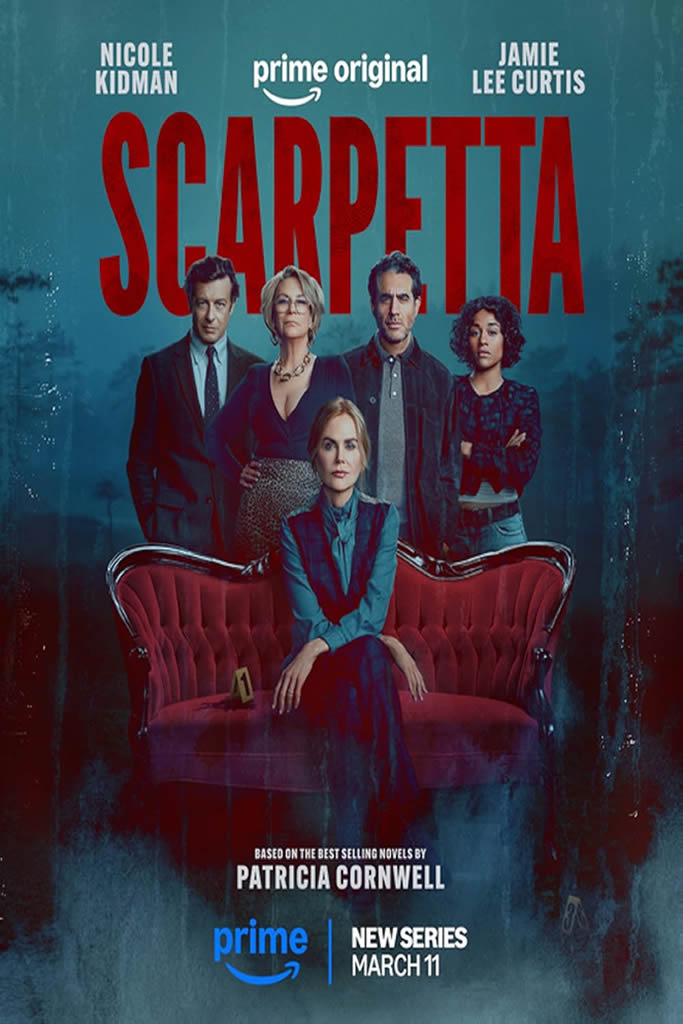
Scarpetta on Sunset: A Precision-Built Crime Thriller Redefines Forensic Drama for the Global Streaming Era
The arrival of Scarpetta on streaming marks a calculated escalation in how crime dramas are being produced, positioned, and delivered to a global audience. Now available via Amazon Prime Video, the 2026 series is not simply another adaptation of a well-known literary property—it is a deliberate, high-investment translation of one of the most enduring forensic characters in modern crime fiction into a cinematic, psychologically driven streaming format. With Nicole Kidman leading the cast as Dr. Kay Scarpetta, the series immediately establishes itself within the upper tier of prestige streaming releases, combining star power, narrative density, and a production model designed for international scale.
At its core, Scarpetta is built on the foundation of Patricia Cornwell’s long-running series of novels, which began with Postmortem in 1990 and helped define the forensic procedural genre for a generation. The transition from page to screen is not treated as a loose interpretation; instead, it is approached as a structural adaptation, preserving the intellectual rigor and investigative depth that made the original material influential while recalibrating it for serialized streaming. The result is a narrative framework that prioritizes psychological continuity over episodic closure, aligning with how modern audiences consume long-form storytelling.
The series premiered on March 11, 2026, and was developed under the guidance of Liz Sarnoff, with a two-season commitment established at launch. This early multi-season order is not incidental—it reflects a strategic confidence in both the property and its execution. Streaming platforms increasingly favor projects that can sustain long-term engagement, and Scarpetta is engineered accordingly, with layered character arcs and investigative threads that extend beyond a single case or timeline.
Narratively, the series centers on Dr. Kay Scarpetta’s return to Virginia, where she reassumes her role as Chief Medical Examiner. This return is not framed as a simple professional transition; it is constructed as a confrontation with unresolved history. The central investigation—a complex and deeply unsettling homicide—mirrors a case that previously defined Scarpetta’s career, creating a dual timeline of past and present that informs both the procedural elements and the psychological stakes. This structural choice allows the series to operate on multiple levels simultaneously: as a crime investigation, as a character study, and as an exploration of memory, trauma, and professional identity.
The supporting cast reinforces this layered approach. Jamie Lee Curtis appears as Dorothy Farinelli, Scarpetta’s sister, introducing a familial dynamic that extends beyond the confines of the investigation. Bobby Cannavale takes on the role of Pete Marino, a character whose law enforcement perspective provides a counterbalance to Scarpetta’s forensic methodology. Simon Baker portrays Benton Wesley, adding an analytical and psychological dimension, while Ariana DeBose brings a contemporary edge to Lucy Farinelli-Watson. This ensemble is not assembled for surface-level recognition; it is structured to support a narrative that relies heavily on interpersonal tension, professional conflict, and evolving alliances.
From a stylistic standpoint, Scarpetta distinguishes itself by adopting a tone often described as an “American giallo.” This classification is not used lightly. It signals a deliberate incorporation of visual intensity, psychological distortion, and thematic boldness more commonly associated with European thriller traditions. The series does not sanitize its subject matter. Instead, it leans into the realities of forensic work—the physicality of examination, the ambiguity of evidence, and the emotional toll of repeated exposure to violence. Scenes are constructed to challenge the viewer, not merely to inform them, creating an experience that is as immersive as it is unsettling.
Production choices further reinforce this identity. Although the narrative is set in Alexandria, Virginia, principal photography took place in Nashville, Tennessee. This decision reflects a broader industry trend of leveraging production infrastructure and logistical advantages while maintaining narrative authenticity through set design and location control. The visual result is a controlled environment that supports the series’ darker tonal palette, with interiors and urban landscapes designed to emphasize isolation, precision, and tension.
The global distribution model is equally significant. Streaming in more than 240 countries, Scarpetta is positioned as a worldwide release from the outset, not a domestic property with secondary international rollout. This approach aligns with the evolving economics of streaming, where content must resonate across diverse markets while maintaining a consistent narrative identity. Crime thrillers, particularly those grounded in procedural logic and psychological depth, have proven to be highly exportable, and Scarpetta is engineered to capitalize on that demand.
Beyond its immediate narrative and production attributes, the series also reflects a broader shift in how forensic storytelling is being approached. Earlier generations of crime dramas often prioritized resolution—identifying the perpetrator, closing the case, and restoring order. Scarpetta operates differently. It acknowledges that resolution does not erase impact. Each case leaves a residual effect on the individuals involved, particularly those responsible for interpreting and documenting the evidence. This perspective introduces a level of realism that extends beyond procedural accuracy into emotional authenticity.
The character of Kay Scarpetta herself remains central to this evolution. Inspired in part by real-life forensic professionals, including former Virginia chief medical examiner Marcella Farinelli Fierro, the character has always occupied a space between scientific objectivity and human vulnerability. The series amplifies this duality, presenting Scarpetta as both a highly disciplined investigator and an individual navigating the cumulative weight of her experiences. Nicole Kidman’s portrayal emphasizes control, restraint, and precision, avoiding exaggeration in favor of a performance that aligns with the methodical nature of the profession.
Even the title carries layered meaning. In Italian, “scarpetta” translates to “little shoe,” but its more common usage—fare la scarpetta—refers to the act of using bread to absorb the remaining sauce from a dish. Within the context of the series, this concept resonates metaphorically. It suggests a process of extracting every remaining detail, leaving nothing behind, and ensuring that no element of a case is overlooked. It is an apt representation of the forensic mindset: thorough, exacting, and unwilling to accept incomplete conclusions.
As a streaming release, Scarpetta arrives at a moment when audience expectations for crime dramas have shifted significantly. Viewers are no longer satisfied with formulaic narratives or surface-level character development. They expect depth, continuity, and a level of production quality that rivals feature films. This series meets those expectations by integrating strong source material, disciplined writing, and a cast capable of sustaining complex, long-form storytelling.
For Sunset’s streaming ecosystem, the inclusion of Scarpetta represents more than a content addition—it signals alignment with a category of programming that prioritizes substance, scale, and sustained engagement. It is a series designed not for passive viewing but for active consumption, encouraging audiences to follow intricate narrative threads and engage with characters whose motivations and histories are continuously evolving.
Now streaming globally on Amazon Prime Video, Scarpetta establishes itself as a defining entry in the 2026 crime thriller landscape. It does not attempt to reinvent the genre through novelty alone; instead, it refines and intensifies the elements that have always defined it—investigation, character, and consequence—delivering a series that is both grounded in its origins and fully adapted to the demands of modern streaming.