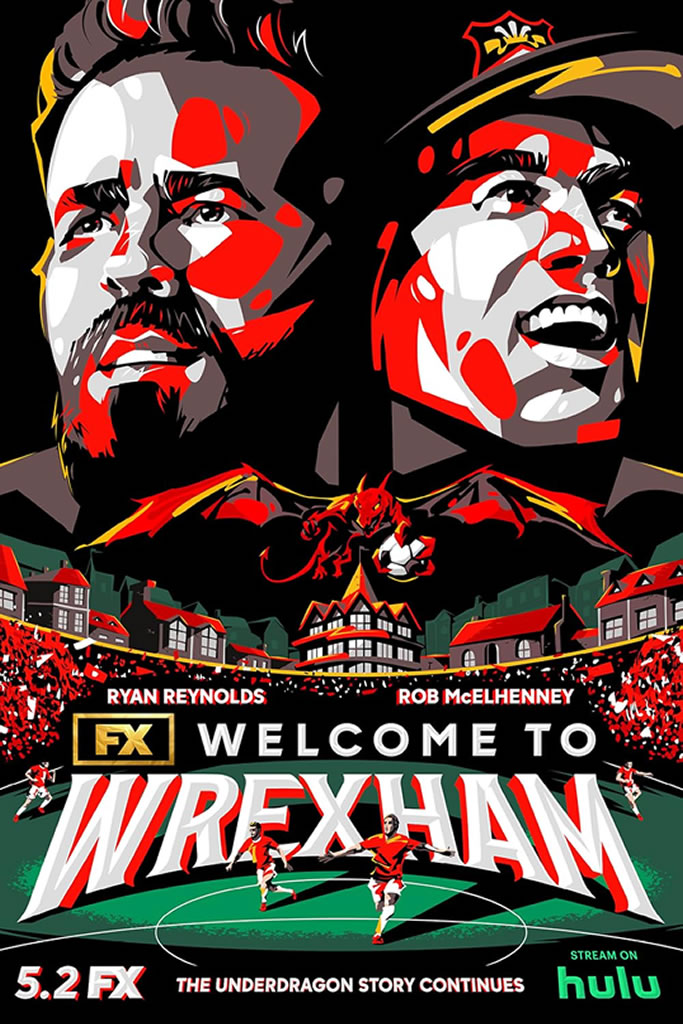
Welcome to Wrexham Season 5 Elevates the Club, the Town, and the Global Football Story Into Something Far Bigger Than a Sports Documentary
Few modern sports documentaries have managed to evolve from a curiosity-driven celebrity acquisition story into a globally respected long-form chronicle of civic identity, economic revitalization, and competitive ambition quite like Welcome to Wrexham. What began as an unlikely partnership between two Hollywood actors and one of the oldest football clubs in the world has transformed into one of the most emotionally resonant and commercially successful sports docuseries operating anywhere in streaming television today. Now, with Season 5 officially premiering on May 14, 2026, the series enters its most consequential chapter yet as Wrexham A.F.C. attempts to survive and compete in the brutally demanding environment of the EFL Championship.
Streaming now through Hulu in the United States and internationally through Disney+, the latest season arrives carrying expectations that would have sounded impossible just a few years ago. The club’s rise through the English football pyramid has not merely exceeded projections—it has fundamentally altered the perception of what lower-division football storytelling can achieve in the streaming era. At this point, Welcome to Wrexham is no longer simply documenting a football club. It is documenting the transformation of an entire ecosystem.
Executive stewards Ryan Reynolds and Rob McElhenney remain central figures in the narrative, but one of the defining strengths of the series is its refusal to make them the sole focal point. Their visibility may have ignited the international spotlight, but the series consistently redirects attention toward the people whose lives are intertwined with the club itself: supporters, local business owners, employees, families, players, and residents whose generational connection to Wrexham predates the cameras by decades.
That narrative discipline is what separates the series from celebrity vanity programming. Welcome to Wrexham operates with a distinctly human infrastructure. Football serves as the catalyst, but the real subject matter is belief—how a struggling community rebuilds identity through collective momentum, and how sport becomes a mechanism for regional pride, emotional continuity, and economic optimism.
Season 5 raises the stakes dramatically because the environment itself changes. The EFL Championship is not merely another step upward in competition; it is one of the most unforgiving leagues in professional football. Financial disparities intensify. Match schedules become relentless. Promotion pressure increases exponentially. Clubs operating in the Championship are often positioned either one step away from the financial goldmine of the Premier League or one collapse away from instability. This season captures that reality with far greater tension than previous installments.
The significance of Wrexham achieving three consecutive promotions cannot be overstated. In practical football terms, it borders on historic improbability. The series understands this and treats the accomplishment not as a gimmick, but as an operational miracle requiring constant recalibration. Every success creates larger logistical demands. Every victory raises the club’s profile while simultaneously increasing scrutiny.
What continues to make the series compelling is its refusal to sanitize the complexity of ownership. Reynolds and McElhenney are portrayed not as infallible saviors, but as individuals learning in real time how emotionally consuming football culture can become. Their initial enthusiasm has evolved into genuine responsibility. Season 5 reflects that transition more than any previous chapter. The stakes are no longer symbolic or experimental; they are structural and financial. Decisions now carry consequences that ripple across staff, supporters, infrastructure, sponsorships, and long-term sustainability.
The production quality remains remarkably sophisticated throughout the new season. Cinematically, the series continues to blend broadcast sports intensity with grounded documentary realism. Matchday sequences are edited with escalating tension, while quieter moments inside homes, pubs, offices, and training facilities preserve the intimacy that has become the series’ signature. This balance is essential because it reinforces the core thematic principle driving the show: football clubs do not exist independently from their communities—they reflect them.
Another major factor behind the series’ enduring success is authenticity. In an era where many sports documentaries lean heavily on dramatization or manufactured conflict, Welcome to Wrexham gains power through emotional transparency. The supporters are not presented as background scenery. Their emotional investment becomes part of the architecture of the show itself. The town’s economic resurgence, tourism growth, increased international visibility, and renewed civic energy are not side stories; they are central outcomes of the club’s ascent.
That authenticity has translated directly into industry recognition. The Emmy-winning series has become one of the most critically respected sports documentaries of the streaming era because it transcends football literacy. Viewers do not need deep tactical knowledge of the sport to understand ambition, pressure, heartbreak, or hope. The show’s emotional accessibility has helped transform Wrexham from a historically regional football institution into a globally recognized cultural brand.
Season 5 also arrives with long-term stability already secured. FX and Disney have formally renewed the series through Seasons 6, 7, and 8, guaranteeing continuation through at least 2029. That commitment signals confidence not only in audience performance metrics, but in the sustainability of the broader narrative itself. There is still upward momentum here. The story is still actively unfolding.
Importantly, the club’s evolution mirrors the evolution of the documentary. Early seasons focused heavily on introduction and adjustment. Current seasons are now about maintenance, pressure management, expectation, and institutional growth. The scale is larger. The consequences are greater. The emotional volatility intensifies because the possibility of genuine top-tier football no longer feels theoretical.
The series also continues to succeed because it understands the mythology of football without romanticizing it beyond recognition. Success is never portrayed as automatic. Promotion does not erase operational strain. Momentum does not eliminate risk. Every achievement creates a new threshold that must immediately be defended. That realism gives the documentary its credibility and keeps it grounded even as the club itself becomes increasingly global.
Streaming now on Sunset through Hulu and Disney+, Welcome to Wrexham Season 5 represents the series at its most ambitious, emotionally layered, and culturally significant stage to date. It is no longer simply a documentary about ownership or football promotion. It is a long-form examination of transformation—of a club, a town, a business model, and a global audience discovering that sports storytelling can still feel deeply personal in an era dominated by manufactured spectacle.
At its core, Welcome to Wrexham continues to prove something increasingly rare in modern entertainment: authenticity scales. And as Wrexham steps deeper into one of football’s harshest competitive landscapes, the documentary following that journey becomes even more compelling because the stakes are no longer imagined. They are entirely real.