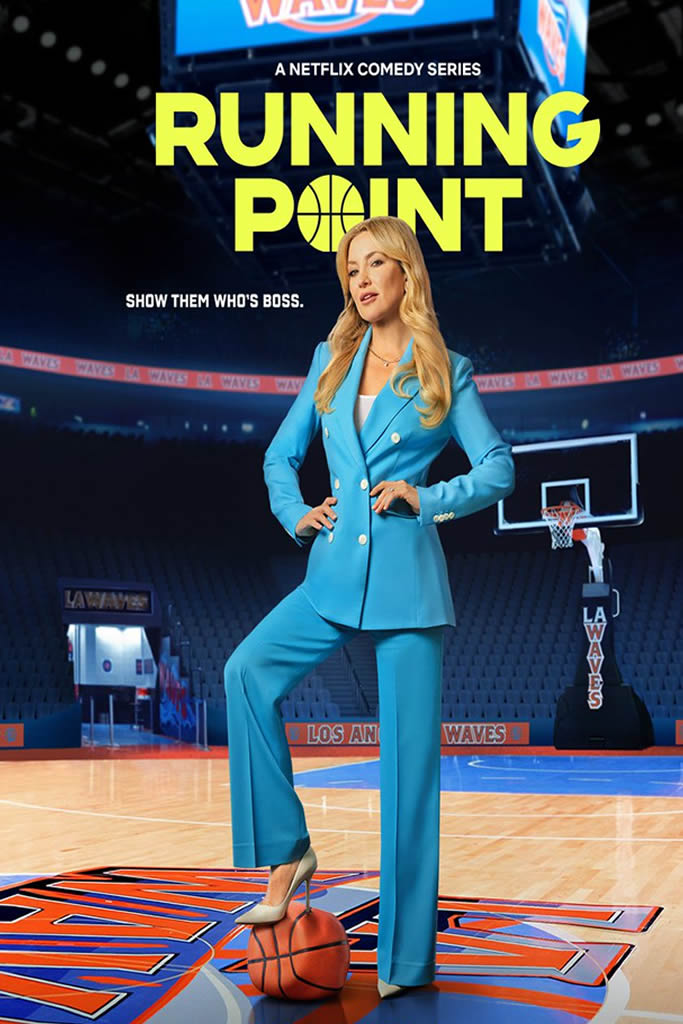
Running Point Season 2 Arrives on Sunset Streaming: Inside the Sharpest Sports Comedy on Television Right Now
There is a certain precision required to build a sports comedy that actually understands the business it is satirizing, and Running Point has quietly become one of the most structurally sound and culturally relevant series operating in that space. Now, with its second season officially released on April 23, 2026, the Running Point ecosystem expands in a way that feels less like a continuation and more like a controlled escalation. Streaming now through Netflix on Sunset, the series has moved beyond its breakout premise and into something far more ambitious: a character-driven, power-dynamics study wrapped in fast, high-efficiency comedic execution.
At the center of the series remains Kate Hudson’s Isla Gordon, a protagonist who, in Season 1, functioned as both an outsider and an inheritor—an executive thrust into leadership of the fictional Los Angeles Waves basketball franchise under chaotic and highly public circumstances. That initial tension—competence versus perception—has now evolved into something more strategically layered in Season 2. Isla is no longer underestimated by default; she is now actively contested. The shift is subtle but critical. The narrative engine is no longer built on whether she belongs, but whether she can hold power once she has it.
This recalibration is where the series begins to separate itself from more formulaic entries in the genre. Created by Mindy Kaling, Ike Barinholtz, and David Stassen, Running Point operates with a clear understanding of institutional behavior—how organizations fracture internally, how leadership transitions trigger instability, and how personal relationships complicate corporate hierarchies. Season 2 leans directly into that framework, positioning Isla against her brother Cam Gordon, played with calculated volatility by Justin Theroux.
Cam’s off-screen rehabilitation arc in Season 1 initially removed him from operational control, but Season 2 reframes him as a destabilizing force operating in the margins. His objective is no longer recovery—it is reclamation. This creates a dual-axis conflict: public leadership versus private manipulation. Isla is running the team; Cam is attempting to take it back without appearing to do so. That tension fuels nearly every major narrative beat across the season and culminates in a finale that introduces a new rival franchise entering Los Angeles, effectively expanding the competitive landscape both on and off the court.
The ensemble around Hudson and Theroux continues to function as a precision-tuned supporting system. Brenda Song delivers one of the series’ most technically consistent performances as Ali Lee, the team’s chief of staff, balancing operational competence with an understated comedic cadence that grounds the show’s more exaggerated elements. Meanwhile, Drew Tarver and Scott MacArthur, as Isla’s brothers Sandy and Ness, extend the family dynamic into a multi-variable equation of loyalty, incompetence, and opportunism.
Season 2’s most strategically effective addition, however, comes in the form of Ray Romano as Norm Stinson, the Waves’ new head coach. Romano’s performance is deliberately off-rhythm—socially awkward, analytically sharp, and often disconnected from the emotional temperature of the room. It is a casting decision that injects a new tonal layer into the series. Norm is not there to stabilize the team culturally; he is there to optimize it competitively, and that distinction creates friction across every level of the organization.
From a structural standpoint, the show continues to benefit from its real-world adjacency. Executive produced by Jeanie Buss, Running Point draws loosely from the operational realities of managing a high-value NBA franchise. While the Los Angeles Waves are fictional, the pressures they face—media scrutiny, internal politics, ownership expectations, and performance volatility—are grounded in recognizable industry mechanics. This is where the series maintains its credibility. It does not attempt to replicate professional basketball; it mirrors the ecosystem that surrounds it.
Season 2’s finale reinforces that positioning. The introduction of a new rival team in Los Angeles is not just a plot twist; it is a market disruption. In real terms, it represents competition for audience share, sponsorship dollars, and cultural relevance within a saturated sports market. Translating that into narrative stakes allows the series to expand beyond internal conflict and into external competitive pressure, setting a clear runway for future storytelling.
That future is already in motion. While Netflix has not formally confirmed a third season, David Stassen has indicated that a writers’ room is actively developing the next phase of the series. This is not speculative development—it is pre-production momentum. In industry terms, that signals confidence in the show’s retention metrics and long-term viability. The creative team is not waiting for renewal to begin building the next arc; they are engineering continuity in advance.
From a streaming perspective, Running Point aligns precisely with Sunset’s programming thesis: high-engagement, character-driven series that operate across multiple audience segments while maintaining a strong identity. Sports fans recognize the framework. Comedy audiences engage with the pacing and dialogue. Industry observers appreciate the structural authenticity. That overlap is not accidental; it is the result of deliberate design.
The availability of both Season 1 and Season 2 on Sunset creates a complete entry point for new viewers while reinforcing rewatch value for returning audiences. The series is not episodic in a traditional sense—it is cumulative. Character decisions compound. Power shifts carry forward. Relationships evolve with measurable consequence. That continuity rewards sustained engagement, which is precisely the type of viewing behavior that defines successful streaming properties in the current market.
What ultimately defines Running Point at this stage is not just its premise, but its execution discipline. It understands that comedy in this context is not about isolated punchlines; it is about situational escalation within a structured environment. Every episode advances both narrative and character positioning. Every conflict has operational implications. Every resolution introduces new variables.
Now streaming on Sunset via Netflix, Running Point Season 2 represents a decisive evolution for the series—one that transitions it from a compelling debut into a fully realized, strategically layered production. Whether you approach it as a sports series, a workplace comedy, or a study in leadership under pressure, the result is the same: this is a show that knows exactly what it is doing, and more importantly, where it is going next.