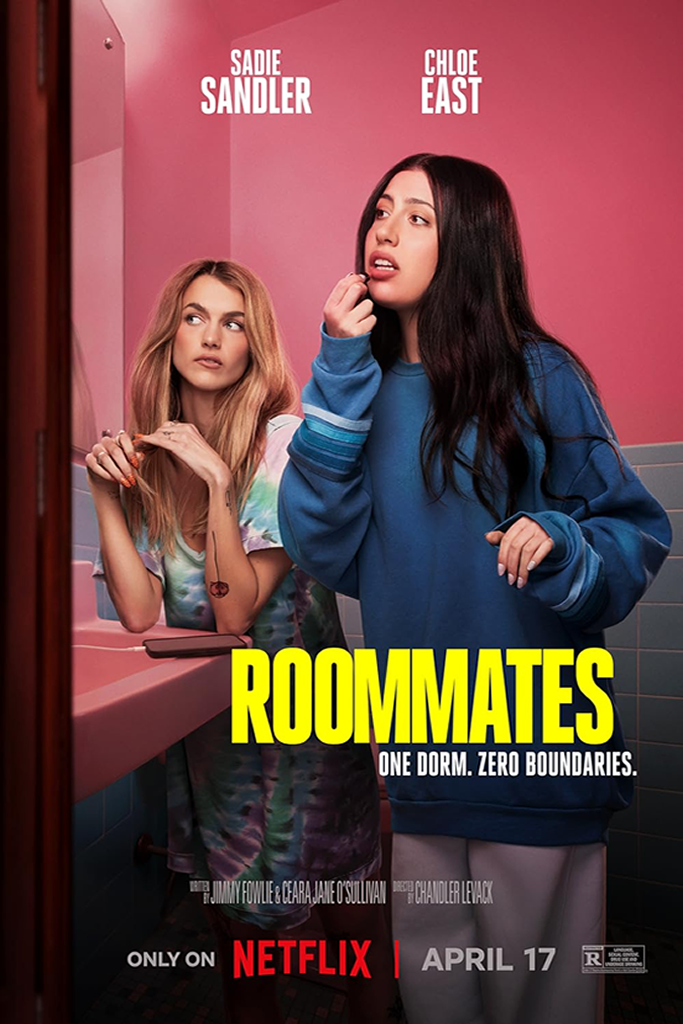
Sunset Picks This Week: Roommates Is the Sharp, Unfiltered College Comedy That Quietly Took Over Streaming
There’s a specific kind of comedy that works best when it feels just slightly uncomfortable—where humor is rooted in truth, character friction, and the slow unraveling of relationships that were never built to last. Roommates lands squarely in that space, and it does so with a level of control and confidence that makes it one of the more effective streaming releases currently circulating. Premiering globally on Netflix on April 17, 2026, the film arrives without unnecessary noise and instead builds its reputation through execution, tone, and a cast that understands exactly what kind of story this is.
Produced by Adam Sandler under the Happy Madison banner, the film represents a subtle but notable shift in direction for that production pipeline. While Sandler himself does not appear on screen, his presence is still felt structurally—particularly in how the film balances absurdity with grounded character work. More importantly, Roommates serves as a clear breakout vehicle for Sadie Sandler, who takes on the lead role of Devon Weisz with a performance that is far more controlled and nuanced than typical genre expectations.
Devon is introduced as a reserved, slightly awkward college freshman navigating the unfamiliar terrain of independence for the first time. Her decision to room with Celeste Durand—played with sharp precision by Chloe East—initially feels like a step toward reinvention. Celeste is confident, socially fluent, and everything Devon is not, creating a dynamic that begins with admiration and quickly evolves into imbalance. That imbalance is where the film finds its identity.
Rather than rushing into conflict, the narrative takes its time allowing tension to build organically. Small irritations compound into passive-aggressive exchanges, which then escalate into deliberate acts of retaliation. What begins as a mismatched friendship gradually transforms into a sustained psychological standoff, where neither character is fully right nor entirely wrong. This is where Roommates distinguishes itself from more formulaic comedies—it commits to the discomfort, refusing to simplify the relationship into easy resolutions or predictable arcs.
Director Chandler Levack approaches the material with restraint, allowing scenes to breathe and performances to carry weight without over-direction. The script, written by Jimmy Fowlie and Ceara O’Sullivan—both with roots in Saturday Night Live—leans heavily into character-driven humor rather than relying on punchline density. The result is a tone that feels closer to observational satire than traditional studio comedy, which ultimately gives the film more longevity in a streaming environment.
Supporting performances add another layer of credibility. Nick Kroll and Natasha Lyonne bring a grounded, slightly chaotic energy as Devon’s parents, while Sarah Sherman injects a distinct narrative voice as the university dean who frames the story with a mix of detachment and dry commentary. The extended ensemble—including Storm Reid, Carol Kane, Janeane Garofalo, and Steve Buscemi—adds texture without overwhelming the central dynamic, while the unexpected cameo from Megan Thee Stallion is used with restraint rather than as a distraction.
From a thematic standpoint, Roommates is less about college life itself and more about identity under pressure. The film explores how proximity accelerates both connection and conflict, particularly when individuals are still forming a sense of self. It also examines the subtle ways power shifts within friendships—who defines the terms, who adapts, and what happens when that balance breaks. These are ideas that could easily become heavy-handed, but the film avoids that by keeping its focus tightly on behavior rather than exposition.
What ultimately makes Roommates effective is its discipline. It understands its scope and commits to it fully. There are no unnecessary detours, no tonal whiplash, and no reliance on exaggerated set pieces to compensate for weak storytelling. Instead, it builds tension through repetition, escalation, and character choice, allowing the humor to emerge naturally from increasingly uncomfortable situations.
As a streaming release, the film is positioned perfectly. Its contained setting, performance-driven narrative, and replay value make it ideal for on-demand viewing, where audiences are more attuned to character nuance than spectacle. It also signals a broader evolution within the Happy Madison ecosystem—one that prioritizes structure and storytelling over formula, which could have longer-term implications for future projects coming through that pipeline.
For Sunset, this is exactly the kind of film that earns a place in a weekly spotlight. It’s not chasing trends or leaning on nostalgia. It’s a controlled, well-executed piece of work that understands its audience and delivers with precision. Roommates may present itself as a college comedy, but beneath that surface is a far more deliberate and sharply observed film—one that proves restraint and clarity can still define standout releases in a crowded streaming landscape.