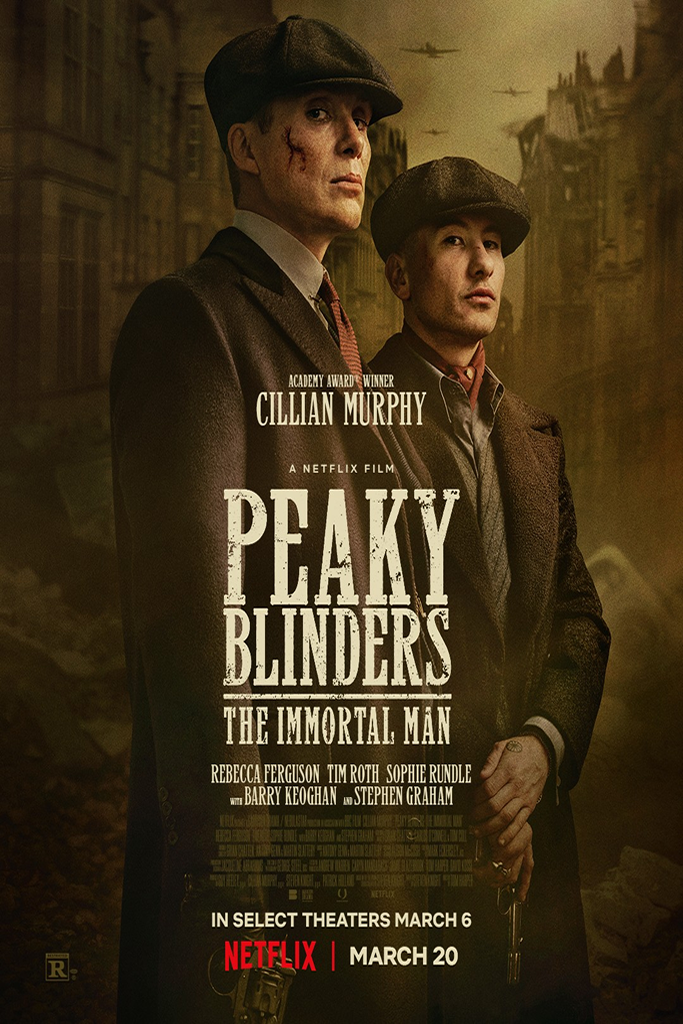
Sunset Presents: Peaky Blinders Returns — A Cinematic Reckoning Streaming Now
There are stories that entertain—and then there are stories that linger, evolve, and ultimately demand a final confrontation. Streaming now, Peaky Blinders arrives not as a continuation, but as a culmination. A decisive chapter that transforms a globally recognized series into a full-scale cinematic event.
Released on March 20, 2026, and distributed by Netflix, this long-awaited film marks the return of one of modern storytelling’s most complex figures: Tommy Shelby. And this time, the stakes extend far beyond Birmingham’s streets—into the broader turmoil of a world at war and a legacy on the brink of collapse.
A War-Torn World Meets a Man at War With Himself
Set against the chaos of World War II, the film reintroduces Tommy Shelby not as a rising power, but as a man emerging from self-imposed exile, carrying the weight of decisions that have reshaped both his family and his identity.
This is not the calculated strategist audiences once followed with precision. This is a man confronting:
- The consequences of ambition
- The erosion of loyalty
- The psychological toll of power
The narrative is structured around a singular question:
What remains when control is no longer absolute?
In this new chapter, Tommy is forced into a position he has long avoided—facing his own legacy without the shield of strategy or distance.
Direction and Vision: Expanding the Scale
Under the direction of Tom Harper, the film elevates the Peaky Blinders universe into a more expansive cinematic language.
Harper brings a visual and tonal shift that aligns with the gravity of the story:
- Larger, more immersive set pieces reflecting wartime instability
- A darker, more introspective pacing that prioritizes psychological tension
- A refined balance between character-driven narrative and historical backdrop
This is not episodic storytelling stretched into a feature—it is a purpose-built film, designed to carry the emotional and narrative weight of everything that came before it.
Creative Leadership: A Continuity of Vision
The film’s production team ensures continuity while expanding the scope:
- Cillian Murphy
- Steven Knight
- Caryn Mandabach
- Guy Heeley
This collaboration preserves the DNA of the original series while adapting it to a format that demands higher stakes and broader narrative resolution.
Murphy’s dual role as both lead actor and producer further deepens the authenticity of Tommy Shelby’s portrayal—this is a performance shaped not just by script, but by long-term character investment.
Runtime and Structure: Precision Over Excess
With a runtime of 1 hour and 52 minutes, the film operates with deliberate efficiency. Every scene, every exchange, every moment of silence serves a purpose.
The pacing reflects:
- A tightening of narrative focus
- A commitment to emotional clarity
- A refusal to dilute the intensity of the story
This is not a sprawling epic—it is a controlled detonation.
Themes: Legacy, Power, and Final Choices
At its core, the film explores three interconnected themes:
1. Legacy Under Pressure
Tommy Shelby’s influence has extended beyond crime into politics, business, and national identity. Now, he must confront what that influence has cost—and what it has created.
2. The Illusion of Control
For years, Shelby operated with near-total command of his environment. In a world defined by global conflict, that control begins to fracture.
3. Redemption or Destruction
The central tension of the film lies in a binary choice:
- Confront the past and attempt to reshape the future
- Or embrace the chaos and allow everything to collapse
There is no middle ground.
Why This Release Matters Now
The arrival of Peaky Blinders as a feature film is not just a continuation of a successful series—it is a reflection of how storytelling is evolving in the streaming era.
Platforms like Netflix are no longer simply distributing content—they are enabling:
- The transformation of television narratives into cinematic events
- The extension of character-driven stories into new formats
- The ability to deliver globally synchronized releases with immediate cultural impact
This film represents the convergence of:
- Prestige television storytelling
- Feature-length cinematic ambition
- Streaming accessibility at scale
Streaming on Sunset: A Curated Experience
As part of Sunset’s featured streaming lineup, Peaky Blinders is positioned not just as content, but as a must-experience release.
This is the type of project that aligns with Sunset’s core philosophy:
- Elevated storytelling
- Cultural relevance
- High-impact viewing experiences
It is not background entertainment.
It is a destination.
The Performance: A Defining Turn
Cillian Murphy’s portrayal of Tommy Shelby reaches a new level of depth in this film. Years of character development culminate in a performance that balances:
- Restraint and volatility
- Precision and unpredictability
- Authority and vulnerability
This is not the same Tommy Shelby audiences met at the beginning of the series. This is a man shaped by everything he has built—and everything he has lost.
The Bottom Line
Peaky Blinders (2026) is not simply a return—it is a resolution.
It delivers:
- A character study at its most intense
- A narrative shaped by consequence rather than ambition
- A cinematic experience that honors its origins while redefining its scale
Streaming now, the film stands as one of the most significant releases of the year—an intersection of storytelling, performance, and cultural impact.
And at the center of it all is a single, unavoidable truth:
Every empire reaches a moment where it must face itself.